
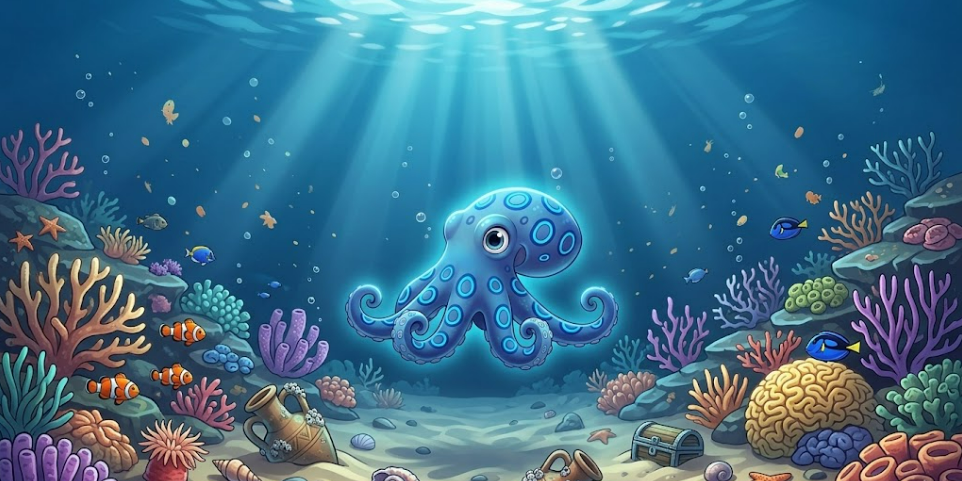

In the deepest parts of the ocean lies some of the toughest most adapted animals on the planet. They have to live in insane pressure and a freezing environment. You would probably expect to find a monster down there. Instead, scientists exploring the deep sea just found a beautiful, bright blue octopus that’s literally only the size of a golf ball. This cute little creature is a brand-new discovery. On May 25, 2026, scientists gave it the official name Microeledone galapagensis.
Where Is It Found?
This tiny octopus lives near the Galápagos Islands out in the Pacific Ocean. It doesn’t hang out in the shallow, sunny areas where people swim. Instead, it was found chilling on the rocky side of a giant underwater volcano, 5,800 feet deep. Down there, it is totally pitch black, freezing cold, and the water presses down with immense weight.
Who Discovered It?
A team of scientists from all over the world were exploring the ocean floor on a huge research ship named the EV Nautilus. Since humans would get crushed diving that deep, they stayed on the ship and sent down a ROV (Remotely Operated Vehicle) named Hercules with bright lights and cameras to look around.
While watching the video feed, the team spotted the mini octopus and brought it up. An animal expert named Dr. Janet Voight from Chicago’s Field Museum studied it to prove it was a brand-new species, officially introducing it to the world on May 25, 2026.
All About The Octopus!
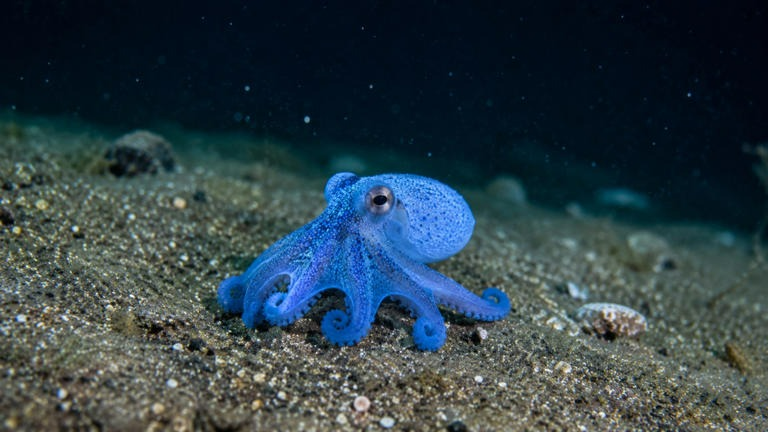
This octopus is incredibly small—only about 4 inches long, so it can easily sit in the palm of your hand. Most deep-sea animals are black or red to blend into the dark, but this one is different with a vibrant sky-blue back.
It also has a brilliant survival trick. While its top is blue, the underside of its arms is a dark, solid purple. Down in the deep sea, a lot of tiny bugs glow in the dark when they get scared. If a normal octopus ate one, the light would shine through its stomach, turning it into a glowing target for predators. To stay safe, this octopus wraps its dark purple arms around its food like a blackout curtain. This traps the light so it can eat in total camouflage.
Even though it looks like a toy, the scientists found out this specific octopus was a fully grown adult mom carrying 13 eggs! Life in the deep ocean is slow because it’s so cold and food is scarce, meaning big octopi take years to hatch and grow up. By staying tiny, this species accelerates the life cycle. It can hatch, grow up, and have babies way faster than other octopi, helping it survive in one of the toughest places on Earth.